The Rise of the Perfect Backdrop: 2014-2019
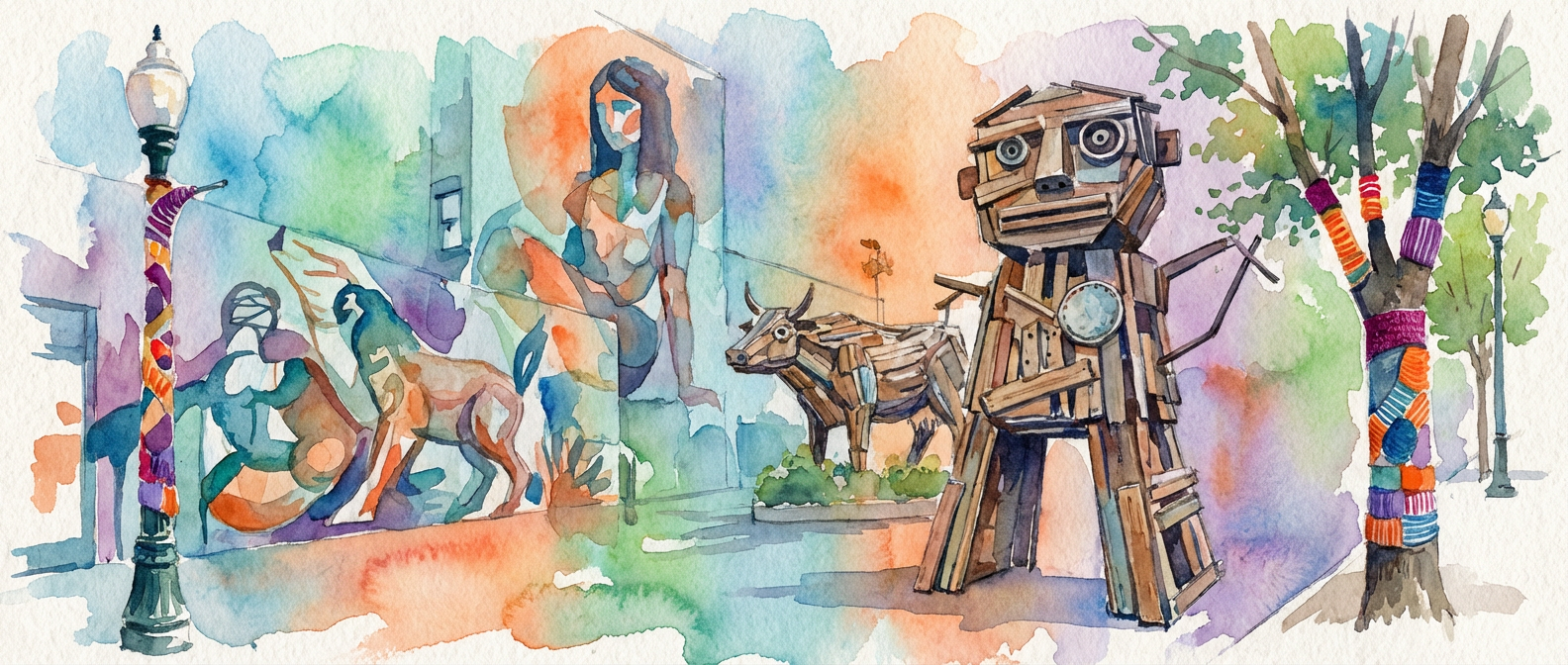
Remember when you first started seeing those angel wings painted on brick walls around 2016? Not the scraggly, spray-painted kind that had been showing up in alleys for decades, but the perfectly symmetrical, photo-ready versions that seemed designed specifically for selfies. That was the moment street art officially entered its Instagram era, and honestly, it was wild to watch in real time.

The shift started around 2014 when businesses figured out that a good mural could bring in more foot traffic than any billboard. I watched this transformation happen on my own block when Maria’s Taco Shop commissioned that massive Day of the Dead piece on their side wall. Within weeks, there were lines of people posing in front of it, and Maria went from struggling to pay rent to hiring two new servers. The mural wasn’t just decoration anymore. It was infrastructure.
Cities caught on fast. By 2017, municipal arts councils were basically mural factories, cranking out Instagram-friendly installations with the efficiency of a social media marketing firm. The formula was simple: bright colors, recognizable imagery, enough space for a person to stand in front without blocking the art. Function followed form, and the form was a vertical rectangle that looked good on a phone screen.
What made this era interesting wasn’t the art itself, but watching traditional street artists navigate this new economy. Some, like my friend Jake who’d been tagging since the early 2000s, refused commissioned work on principle. Others jumped hard into commercial projects, trading the anonymity and risk of illegal work for steady paychecks and city permits. The underground became overground faster than anyone expected.
Peak Content: The Corporate Mural Boom of 2018-2020
By 2018, every major brand wanted their own piece of “authentic” street art. I started keeping a mental list of corporate murals in my neighborhood: the tech startup with the geometric patterns, the boutique fitness studio with the motivational quote in perfect cursive, the coffee chain with the abstract interpretation of their logo. Each one more calculated than the last.
The quality wasn’t necessarily bad, but the purpose had completely shifted. These weren’t expressions of community identity or political resistance. They were outdoor advertisements disguised as cultural experiences. The artists were skilled, often more technically proficient than their illegal predecessors, but they were working within constraints that would have been unthinkable a decade earlier.
This was also when the mural tour industry exploded. Every city with a halfway decent collection of wall art suddenly had companies offering guided walks and bike tours. Brooklyn, Miami, Los Angeles, even smaller cities like Nashville and Austin built entire tourism strategies around their street art scenes. The irony was perfect: an art form that came from communities excluded from traditional galleries was now being packaged and sold back to tourists.
The pandemic initially seemed like it might slow things down, but the opposite happened. With people desperate for outdoor activities and Instagram content, murals became even more valuable as socially distanced entertainment. Cities fast-tracked public art projects as economic stimulus, and the demand for photo-worthy walls reached a fever pitch.
The Backlash: When Everyone Realized They’d Been Played
The turning point came somewhere around 2021, though you could feel the shift building for months before that. People started getting tired of seeing the same aesthetic everywhere. The angel wings, the “Before I Die” walls, the neon-bright geometric patterns. They all began to feel like visual spam. More importantly, communities started pushing back against the gentrification that seemed to follow every new mural like clockwork.
I remember the controversy over the mural project in East Nashville that got canceled after residents pointed out that none of the featured artists actually lived in the neighborhood. Similar fights broke out in neighborhoods across the country as people began connecting the dots between “arts districts” and rising rents. The street art that was supposed to celebrate community character was actively erasing it.
Artists started openly critiquing the Instagram mural industrial complex. Banksy’s 2019 piece mocking street art tourism felt like a cultural moment, but the real shift happened when younger artists began deliberately creating work that couldn’t be easily photographed or commodified. Temporary installations, location-specific pieces that only made sense to people who lived there, work that actively resisted the selfie impulse.
The aesthetic fatigue was real too. By 2022, even the most enthusiastic mural supporters had to admit that most cities looked exactly the same. The same color palettes, the same composition techniques, the same aspirational messaging. What had started as a celebration of local culture had become a franchise operation.
What’s Actually Happening Now
Walking around my neighborhood today, you can see the street art world trying to figure out what comes next. The big, Instagram-friendly murals are still there, but they’re aging badly, literally and culturally. Some are already being painted over, while others stick around like digital billboards that nobody looks at anymore.
The interesting work is happening in the margins again. Artists are going smaller, more conceptual, more integrated with actual community needs. I’ve seen guerrilla installations that double as neighborhood information boards, temporary pieces that respond to local political issues, collaborative projects that care more about process than final product. The tools and techniques developed during the mural boom are being repurposed for more subtle interventions.
Cities are also recalibrating their approach. The smart ones are moving away from tourism-focused public art toward work that puts residents first. This means longer community engagement periods, local artist requirements, and projects that address neighborhood-specific issues rather than generic beautification.
Technology is playing a role too, but not in the way you might expect. Instead of making art more shareable, new tools are making it more ephemeral and location-specific. Augmented reality installations, QR code-triggered experiences, time-sensitive projections that exist only for people who are physically present at specific moments.
The New Underground
The most compelling development is watching a new generation of artists who grew up during the Instagram mural era but are now actively rejecting its basic assumptions. They understand social media as a native language but choose not to speak it, at least not in their art. Their work is harder to find, harder to photograph, and harder to commodify, which feels intentional.
These artists are borrowing techniques from the corporate mural playbook but using them for different ends. High production values in service of genuinely subversive content, technical skill deployed for work that can’t be easily consumed or shared. It’s street art that has learned from its own commodification and is trying to stay one step ahead of the next wave of appropriation.
This isn’t nostalgia for some imagined golden age of street art. It’s adaptation. The landscape has changed permanently, and the most interesting work is coming from artists who understand both what was gained and what was lost during the Instagram years. They’re building something new from the pieces.
I’m curious what you’re seeing in your own neighborhoods. Are the big murals still drawing crowds, or have people moved on to the next thing? And more importantly, what kind of public art actually helps the communities where you live? Hit me up if you’ve spotted something worth paying attention to.