
When Banksy Became a Business Plan
Remember when finding a new piece of street art felt like discovering a secret? I’m talking about 2018, maybe 2019, when you’d turn down an alley in the warehouse district and stumble across something that made you stop mid-stride and actually look up from your phone. Those days are over, and we all watched it happen in real time.
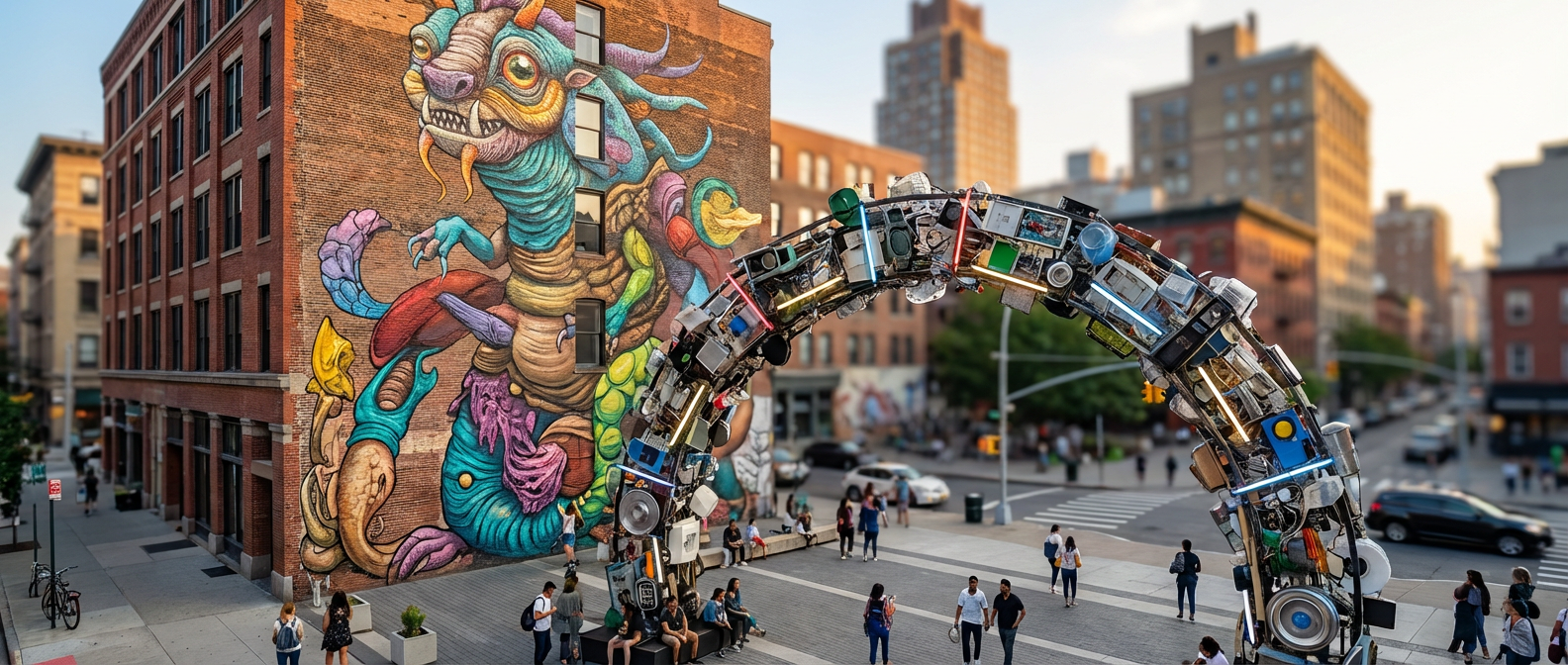
The shift started innocuously enough. Property developers began commissioning murals for their new mixed-use projects, and suddenly every luxury apartment complex had its own “artistic feature wall.” What used to be guerrilla commentary became curated content, complete with Instagram-ready lighting and QR codes linking to the artist’s portfolio. The rebellion got co-opted so smoothly that most people didn’t notice until it was already done.
I watched this transformation firsthand in my own neighborhood, where Maria Santos had been tagging transformer boxes with intricate geometric patterns since 2015. By 2020, she was getting paid $15,000 per mural by the same city council that used to send crews to paint over her work. The irony wasn’t lost on anyone who’d been paying attention, but apparently not many people had been.
The Instagram Effect Changed Everything
Social media didn’t kill street art, but it definitely changed its DNA. Once murals became backdrops for lifestyle photography, their primary function shifted from local communication to global content creation. Artists started designing pieces specifically for their shareability rather than their message, and you could feel the difference walking past them.
The numbers tell the story. In 2017, posts tagged #streetart averaged 847 likes on Instagram. By 2021, that number had jumped to 3,240. The algorithm rewarded bold colors and clear compositions over subtle social commentary, so guess which direction the art moved? Artists who refused to adapt found their work ignored, while those who embraced the platform’s preferences suddenly had gallery representation and brand partnerships.
This wasn’t necessarily bad for individual artists, but it fundamentally altered the medium’s relationship with its environment. Street art used to respond to specific places and communities. Now it responds to an abstract global audience that might never set foot in the neighborhood where the work actually exists. The conversation changed from “What does this place need to hear?” to “What will make people stop scrolling?”
Public Art Goes Corporate
The real turning point came during the pandemic, when cities desperately needed economic development and suddenly discovered that public art could drive foot traffic. What followed was a systematic industrialization of what had once been an organic cultural practice. Municipal art programs exploded from niche budget items to major revitalization strategies.
By 2022, nearly every mid-sized city had launched its own mural festival, complete with corporate sponsors and artist application processes. These events follow an increasingly standardized formula: invite 8-12 artists, assign them walls in the “arts district,” provide paint and scaffolding, document everything for social media, then use the finished murals to attract restaurants and boutiques. It’s efficient, but it’s also predictable in ways that authentic street art never was.
The economics are stark. A commissioned mural that takes an artist three days to complete now costs between $8,000 and $25,000, depending on the city and the wall size. That same investment, according to municipal studies, generates an average of $180,000 in increased property values within a three-block radius. When art becomes that effective at moving money, it stops being art in any meaningful sense and becomes infrastructure.
What Survived the Transition
Despite everything, some genuine street art culture persisted, though you have to know where to look for it. The artists who stayed true to the medium’s roots moved deeper underground, literally and figuratively. They’re working in abandoned subway tunnels, on the undersides of highway overpasses, and in other spaces too difficult or dangerous for sanctioned art programs to reach.
These artists developed new techniques specifically designed to resist commercialization. Wheat-paste installations that deteriorate within weeks. Projection mapping that exists only for a few hours. Chalk and charcoal pieces that wash away with the first rain. The work became more temporary as a direct response to the permanence and commercialization of commissioned murals.
There’s also been an interesting return to text-based work. While Instagram-optimized murals trend toward pure visual impact, the underground scene has embraced words, poetry, and even QR codes that link to temporary websites with longer-form content. These pieces require viewers to slow down and engage rather than simply photograph and move on, which feels like a deliberate rejection of social media’s attention economy.
The Next Phase Is Already Here
We’re now seeing the first signs of what comes after the Instagram era. Augmented reality street art that only exists when viewed through specific apps. Murals with NFC chips that trigger audio content when you tap them with your phone. Some artists are even using blockchain technology to create pieces that change based on real-time data feeds or community voting.
The technology isn’t what matters, though. What matters is that artists are once again finding ways to surprise people, to create experiences that can’t be easily replicated or turned into profit. The medium is remembering how to be unpredictable, which is the closest thing street art has to a core value.
Meanwhile, the corporate mural industry continues expanding, and honestly, that’s fine. Those sanitized art installations do their job in urban development, and some of them are genuinely beautiful. But they’re not street art any more than a craft brewery in a shopping mall is punk rock. They’re something else entirely, and we need different words for them.
I’m curious about what you’re seeing in your own neighborhood. Has the shift from guerrilla art to municipal programming changed how you experience your city? And more importantly, have you noticed any artists pushing back against the trend in interesting ways? The best discoveries always happen when people start sharing what they’ve stumbled across.