The Rebellion Nobody Expected to See on Paper
Something shifted in the underground last year. Not the kind of shift you catch in real time. It’s the kind you notice when you’re standing in a gallery or a basement or somebody’s apartment and you realize half the people around you are holding things that feel expensive because they’re rare, not because they cost money. Zines are back. Not in some nostalgic, retro-boutique way where everyone’s pretending it’s 2003. This is different. People are explicitly rejecting the entire infrastructure of algorithmic generation and choosing to make magazines by hand, one at a time, on paper that could be recycled cardboard or weird specialty stock from a printer who’s been doing this for thirty years.
The numbers tell part of the story. Last year, Printed Matter’s annual art book fair, the oldest and most respected gathering of its kind in North America, saw a 28% jump in first-time zine exhibitors compared to just two years prior. But what matters more than the percentage is what those makers were saying when they set up their tables. They weren’t selling zines. They were selling proof. Proof that a human made this. Proof that no algorithm had a say in it. Proof that this thing in your hands came from a real person’s brain and their actual hands.
The Economics of “No Robots” as Aesthetic Principle
The marketplace figured this out faster than almost anyone predicted. Etsy, which has become the default storefront for independent print makers the way Instagram became the default gallery wall, released internal data in late 2025 that surprised nobody who’s been paying attention: zines and handmade print publications explicitly tagged as AI-free were moving at a 37% price premium compared to identical unmarked items. This wasn’t a small difference. This was customers saying they would literally pay more money to know for certain that their purchase didn’t involve a machine learning model anywhere in the production chain.
That’s not just a market correction. That’s a value system. And a lot of young people have signed onto it. When the Society of Publication Designers 2025 industry report surveyed independent print designers under thirty, 68% of them listed resistance to AI aesthetics as a primary reason for choosing analog production. These are people who grew up with smartphones in their pockets and who could, theoretically, use generative design tools to speed up their work. Instead, they’re choosing to spend four times as long on a project because they want to know where every choice came from.
Where the Movement Actually Lives
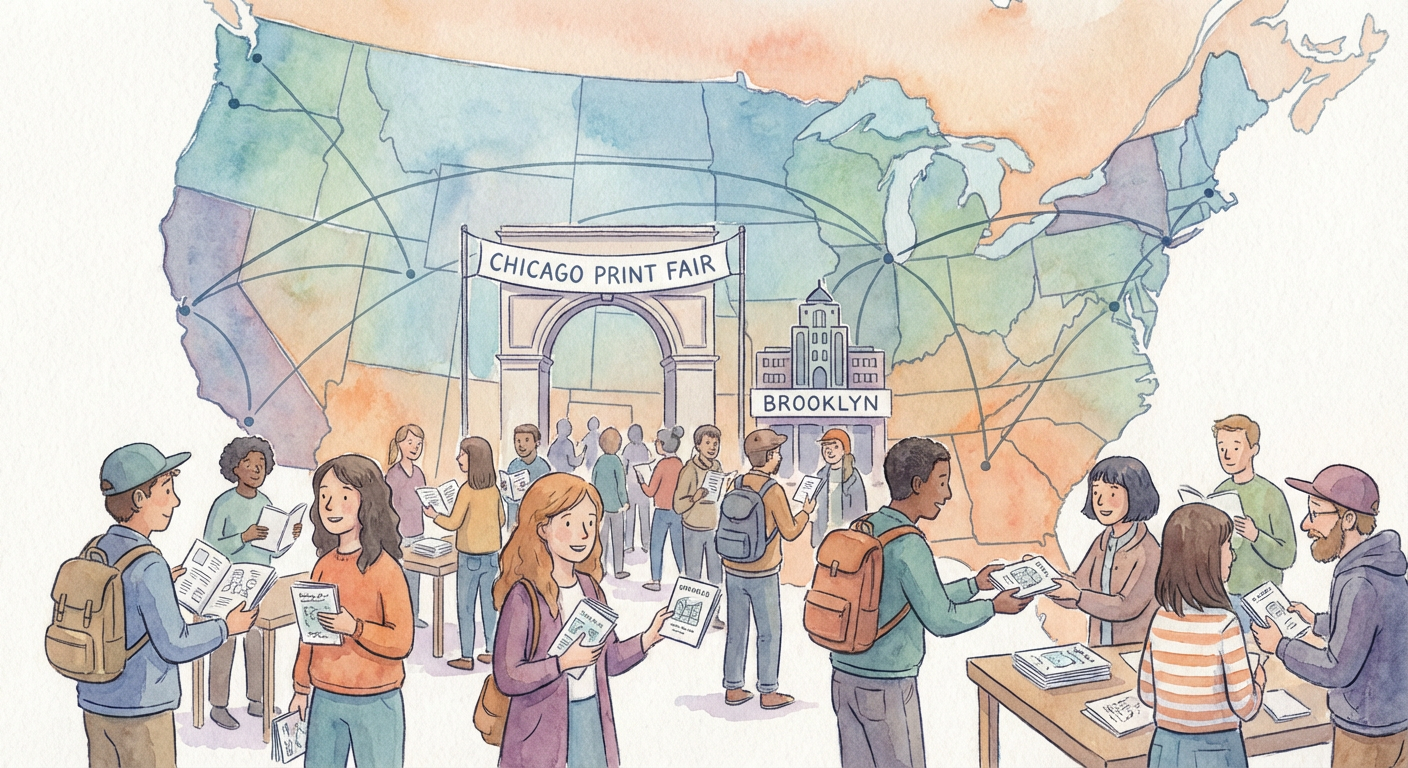
The No Robots collective started in Brooklyn in mid-2024 in that way that things start in Brooklyn, which is to say a few people noticed they were all angry about the same problem and decided to do something about it instead of just posting about it. By January of this year, they had over 3,000 registered zine makers affiliated across 14 American cities. In February, they hosted their first national print fair in Chicago. I talked to someone who went. She said it felt like the thing that printed-matter fairs used to feel like before they got too big and too professional. That exact density of intention.
The collective’s model is simple and radical by current standards: documentation that a zine was made without automated tools. No AI image generation. No algorithm-assisted layout. No machine learning anywhere in the pipeline. It sounds almost absurdly analog until you realize that this is genuinely valuable in a world where you can’t trust visual media anymore. A zine with a No Robots stamp on it is a zine you know you can trust to be what it claims to be.
What Happens When Print Outsells the Algorithm
In London, a small shop called Tenderbooks has been selling art books and zines for twelve years. In that entire period, zines were always secondary. Artist monographs were the main event. But in 2025, something inverted. Zine sales outpaced monograph sales for the first time in the store’s history. The zine section revenue increased 55% year-over-year. The shop’s owner, when asked about it, said something like: people are hungry for something they can actually verify. Something that carries proof of its own authenticity just by existing.
This matters because shops like Tenderbooks are where you find out what people actually want when the algorithm stops dictating the recommendations. They’re the physical world equivalent of what would happen if Instagram got shut down for a week. Real taste re-emerges. Community taste. Not algorithmic taste. And it turns out, when given the choice, a significant number of people want to buy things that come from another human’s hands. They want imperfection. They want irregularity. They want the proof.
The Permanent Lesson of This Moment
Zines aren’t coming back because they’re retro. They’re coming back because they’re honest. That’s a harder thing to build a movement around than nostalgia, and it’s a much better reason. When you put a stapler in someone’s hand and ask them to make a magazine, what they make will look and feel like something a person made. There’s no way around that. No filter between intention and result.
What we’re watching right now is people choosing friction. Choosing process. Choosing verification. It’s not a permanent victory against the machines. But it’s the establishment of something that actually matters: a space where human-made objects have explicit value. Where the fact of their creation is more important than their optimization. Where a zine made by hand, sold in a basement or at a fair or shipped in a padded envelope with a handwritten note, is worth more than the same zine could ever be if an AI had touched it anywhere.
If you want to understand where culture is actually moving right now, stop looking at what the algorithm is promoting. Go to a zine fair. Talk to the people making them. Buy something that came from human hands. Notice how it feels different. Then come back and tell me what you found.