Analog Is Not Dead: Why the Risograph Print Zine Scene Is Outpacing Digital ‘Zine’ Culture and What It Means for Independent Media in 2026

The Numbers Don’t Lie, But They Surprise Everyone

If you’ve been paying attention to the independent media landscape, you’ve probably noticed something feels different lately. It’s not just a feeling. Between 2023 and 2025, Riso Inc. saw a 40 percent global spike in risograph machine sales, and here’s the part that matters: almost none of that growth came from commercial printing operations. It came from independent print studios, art collectives, and people working out of converted warehouses and basement spaces. These aren’t corporations hedging their bets on analog. These are people who actively chose to build their infrastructure around machines that require intention, patience, and genuine connection to the craft.

The online data backs this up in ways that feel almost defiant. Etsy searches for “riso print” and “risograph zine” climbed 89 percent year-over-year in 2025 alone. That’s not a casual uptick. Hand-printed zines that might have sold for eight or ten dollars five years ago now regularly move at eighteen to thirty-five dollars per unit. People are paying more money for something that takes longer to make and cannot be instantly reproduced at scale. That should tell you something about what’s actually happening here.

Why This Moment Feels Different From Past Nostalgia Cycles

Look, I know what you’re thinking. Every decade or so, print gets romanticized again. Vinyl makes a comeback. Typewriters become fashionable. Independent bookstores open in Brooklyn and everyone acts like it’s revolutionary. The risograph movement could just be another cycle of millennial and Gen Z nostalgia, right? But the intentionality here is different, and so is the staying power. The Portland Zine Symposium drew six thousand two hundred people over two days in 2025, with more than a third of exhibitors identifying risograph printing as their primary production method. That’s not a trend. That’s a structural shift in how independent creators are choosing to work.

What makes this genuinely interesting is that it’s not happening because print is trendy. It’s happening because of what print is not. A Reuters Institute Digital News Report 2025 found that forty-one percent of eighteen to twenty-four year olds actively seek out print media for cultural content specifically because it exists outside algorithmic control. That’s the real story. Young people are not embracing risograph zines because they want to be retro. They’re embracing them because the alternative, constant algorithmic mediation of what they see and read, has become genuinely exhausting.

The Production Bottleneck as Evidence of Genuine Demand

Chicago’s Perfectly Acceptable Press represents what happens when an indie operation gets crushed by legitimate demand. As of January 2026, they’re sitting on a three-month backlog of printing commissions. They raised prices twenty-five percent to try to manage the flow of work, and even that didn’t solve the problem. This is not a studio struggling to survive. This is a studio that cannot physically produce enough work to meet market demand at any reasonable price point. If this were a trend, you would expect demand to stabilize or decline as the novelty wore off. Instead, the bottlenecks are getting worse.

What’s happening at Perfectly Acceptable Press is happening at independent print studios across the country, and it’s creating an interesting economic dynamic. These spaces are suddenly viable. They can hire people. They can invest in their equipment. They can say no to work that doesn’t fit their vision. That’s a fundamentally different position for independent media creators than what existed even three or four years ago.

The Uncomfortable Truth About Algorithms and Cultural Real Estate

Here’s where I need to be honest about something that doesn’t quite fit the feel-good narrative. The resurgence of print-based zine culture is real and valuable, but it’s also becoming something that requires a certain amount of cultural capital and discretionary income to participate in fully. A risograph print zine that costs twenty-five to thirty-five dollars is not the same democratizing force that photocopied zines were in the nineties. Something worthwhile is happening here, but we should be clear-eyed about who can actually participate and at what cost.

At the same time, the fact that younger generations are willing to spend that money, that they’re actively choosing to step outside algorithmic systems even when it’s inconvenient and expensive, suggests something important about where culture is heading. The algorithm crisis is real. It’s not abstract. When nearly half of young adults are actively seeking alternatives, that’s not niche behavior. That’s the emergence of a parallel structure.

What This Means for Independent Media Going Forward

The risograph zine boom is telling us that print is not a throwback. It’s a legitimate alternative infrastructure emerging because digital platforms have failed to be sustainable spaces for creative independence. That doesn’t mean digital media is dead or dying. It means the field is diversifying and creators are spreading their bets across multiple systems.

The durability of this shift depends on whether the economics continue to work. Right now, they do. Creators can make a living. Print studios are viable businesses. Collectors and readers treat zines as worth preserving. If that stays true, if the infrastructure keeps strengthening rather than remaining precarious, then we’re looking at a genuine long-term change in how independent culture gets made and distributed. If prices keep rising and access becomes too restricted, it could calcify into something niche and nostalgic again. That’s still being determined.

What I’m curious about is where this goes from here. Are you making zines? Do you have a favorite print studio? Have you noticed this shift in your own communities? I’d genuinely like to know what you’re seeing where you are.
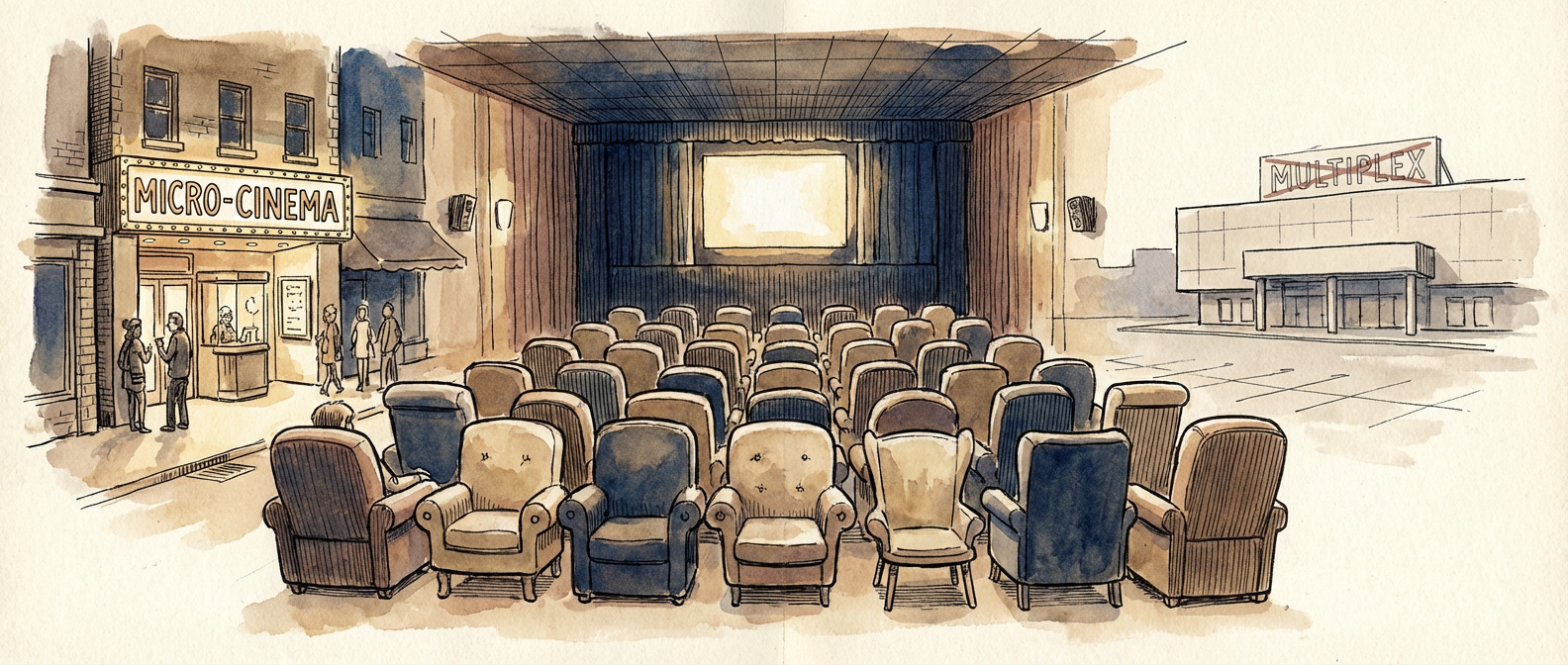
The Micro-Cinema Revival: How 30-Seat Theaters Are Winning Back Our Attention

The Multiplex Is Quietly Losing

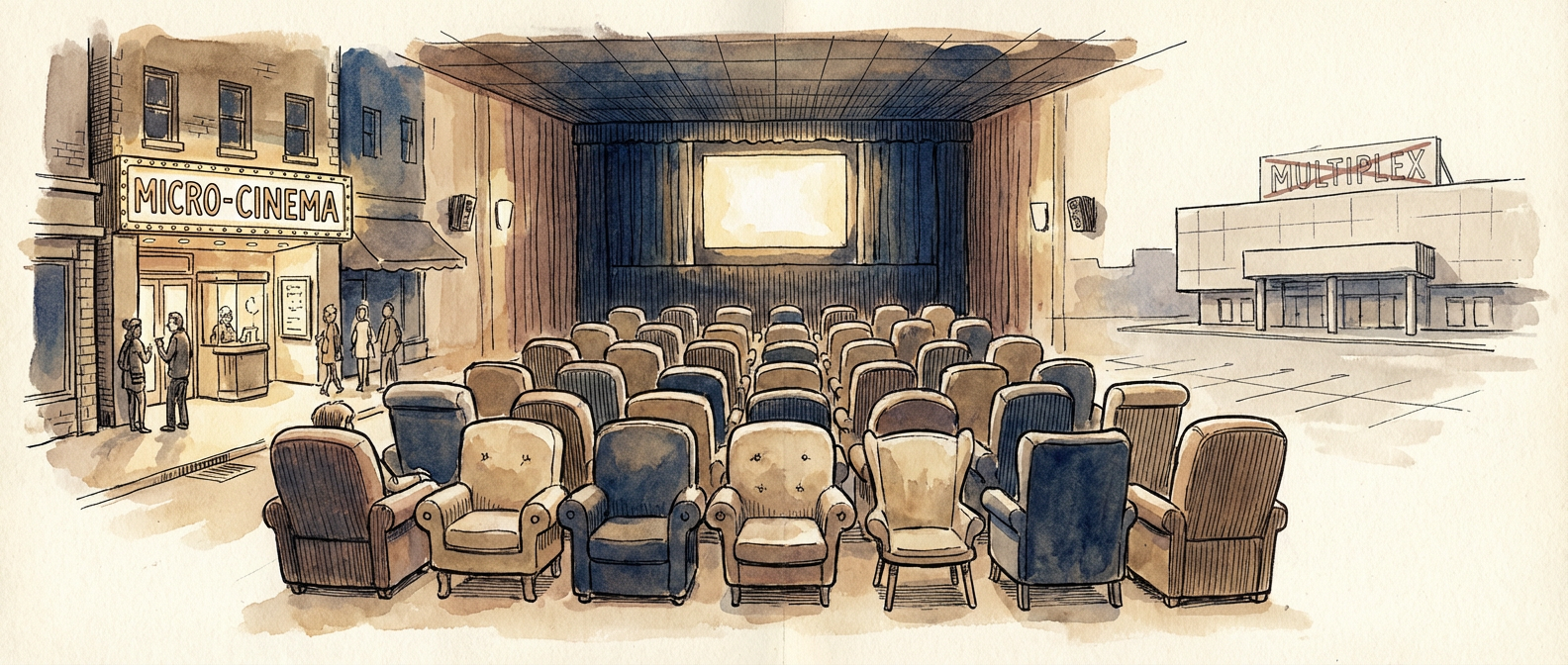
There’s a specific kind of silence that happens when you walk into a massive cinema lobby at 7:45 PM on a Friday night and realize you’re one of maybe seven people there. The sound bounces differently in those cavernous spaces when they’re empty. The staff looks tired in a way that doesn’t quite have a name yet. You buy your ticket for whatever superhero film is playing, sit in a theater designed for 1,200 people, and try not to think about what this moment means.

The Micro-Cinema Revival: How 30-Seat Theaters Are Winning Back Our Attention

The numbers started telling this story quietly in late 2024, but by now they’re impossible to ignore. The UK’s Cinema Exhibitors’ Association reported something that should have made more headlines: independent venues with fewer than 50 seats saw their revenue climb by 27 percent while multiplexes with over 1,000 seats watched their attendance slip 9 percent. That gap is growing. It’s not cyclical. It’s structural. Something has shifted in how we want to experience cinema, and the massive theater chains built on the economics of the 1990s simply didn’t see it coming.

Illustration for The Micro-Cinema Revival: How 30-Seat Theaters Are Winning Back Our Attention

What a 54-Seat Theater in North London Discovered

Lexi Cinema sits in Kensal Rise, which is the kind of neighborhood most people pass through without really noticing. It’s not trendy in an Instagram way. It’s just authentically itself: residential streets, a strong community, the sort of place where people actually live instead of performing living. The cinema holds 54 people. In Q4 2024, it reported a 94 percent average occupancy rate. That’s not just good. That’s nearly full, night after night.

The national multiplex average occupancy was 61 percent. Let that sit for a moment. A tiny venue in North London is running at 94 percent capacity while the massive chains with IMAX screens and premium recliners are watching three-quarters of their seats stay empty most nights. This isn’t happening in one city or one market. This is happening systematically in cities across the UK and North America. The micro-cinema model works because it fundamentally respects something that multiplexes abandoned somewhere in the 2010s: the idea that cinema is social.

The Curator’s Advantage

When Metrograph announced its January 2025 programming calendar, something unusual happened. Every single screening sold out within 72 hours. The venue has 176 seats across two screens. Every program date. Gone. This is a two-screen cinema in Manhattan operating with the scarcity of a hot restaurant reservation, not the accessibility that cinema promised to be.

Here’s what matters: Metrograph doesn’t show the same films as every other cinema. Someone is actually choosing what plays there. There’s a thesis. There’s a voice. You go to Metrograph to see what Metrograph wants you to see, not just whatever the major distributors demand. That curation isn’t a luxury add-on anymore. For younger audiences especially, it’s the entire value proposition. A 2025 Eventbrite report found that 68 percent of people between 18 and 34 actively prefer intimate, curated experiences over large-scale venues. They’re not trying to see the next Marvel film on the biggest possible screen. They’re trying to be somewhere that means something.

The Metrograph NYC Programming model has spread because it works. The Independent Cinema Office UK Data shows that licensed micro-cinema spaces in US cities over 500,000 people grew from 340 locations in 2022 to over 890 by January 2026. That’s a 162 percent increase in less than four years. These aren’t boutique exceptions. This is becoming the dominant model in major markets.

What We’re Actually Losing

There’s something worth naming here that goes beyond attendance figures. When multiplexes decline, we lose things that don’t show up in any revenue report. The theater where a teenager went on their first date. The place where strangers became neighbors through shared screenings. The casual walk-in possibility of cinema, the chance encounter with a film you weren’t planning to see.

Micro-cinemas curate beautifully, but they also curate for an audience. If you’re not in that audience, you might never know they exist. The old multiplex was a democratic space in its own way, even if that democracy was administered by corporate chains. You could show up without planning ahead. You could just go because a film looked interesting and a theater near you happened to have a 7 PM showing.

The gain in intimate, intentional experiences comes paired with a loss of spontaneity and accessibility. That’s the trade. We’re choosing depth over breadth, curation over casualness, community over convenience. Whether that’s a net positive depends partly on where you stand in the city and partly on what you believe cinema should be.

The Future Is Smaller, But Not For Everyone

The micro-cinema revival is real and measurable and it’s reshaping how we experience films. But it’s worth sitting with the fact that this shift concentrates cinema culture in specific neighborhoods and specific cities. The 890 micro-cinemas operating in major US markets represent genuine community and genuine curation. They also represent a market that’s learned to serve its most engaged audience exquisitely while leaving others behind.

What’s happening right now is that cinema is fragmenting. It’s becoming boutique in the literal sense: expensive, selective, requiring knowledge to access. That’s not necessarily a tragedy. Small theaters make better films possible. They make programming risks possible. They create the kind of spaces where something actually matters. But there’s a melancholy in watching the massive theaters empty, knowing that they represented something important too, even if what they represented was mostly just the democratic principle that cinema should be available to anyone with eight dollars and nearby transportation.

If you’ve noticed one of these micro-cinemas opening near you, or if you’ve been meaning to check one out, now’s the moment when they’re actually thriving. The numbers suggest this isn’t a phase. This is what cinema looks like when it survives by mattering more to fewer people instead of mattering less to everyone. What’s your experience been with independent cinemas? Are they reshaping how you experience film, or does something feel different about them to you?

How Brat Became Inevitable: The Six-Month Lag Between Underground Club Reality and Mainstream Recognition

The Thing That Was Already Happening

There’s always a moment when you realize a trend has become real. Not when Rolling Stone writes about it. Not when your mom texts you a screenshot. It’s when you’re standing in a dimly lit basement somewhere, watching a DJ drop their third track of the night and noticing that everyone around you is wearing the exact same shade of chartreuse. That moment arrived for me around late October 2024, at a sold-out night in East London that had gone live on Instagram with zero promotion beyond a WhatsApp group I’m in. The promoter had called it “Brat Energy” and promised a night themed around the aesthetic. Within 48 hours, it was full.

What I didn’t know then was that this exact scenario was playing out in clubs across Berlin, Manchester, Bristol, and Amsterdam. Independent promoters had already cottoned onto something that wouldn’t hit the mainstream conversation for another four months. Charli XCX’s album had dropped in June 2024, landing at number three on the UK Albums Chart, and it would go on to spend over 40 weeks charting globally into 2025. But the underground didn’t wait for the album to become a cultural moment. The underground was already there, already building.

When the Color Becomes the Currency

Here’s the detail that actually matters: that specific shade of green, Pantone 392 C, the one that screams across the album cover and every visual associated with it, became measurable. Pantone tracks this stuff. Designer fabric orders spiked 214 percent in 2025 according to their trend report. This isn’t just people buying green t-shirts. This is textile manufacturers, fashion labels, and club promoters ordering fabric to make banners, backdrops, and visual installations. The physical infrastructure of an aesthetic becoming real.

What’s fascinating is the timeline. The album was out in June. The fabric orders started ramping up in late summer and early autumn. By the time you could buy a Brat-themed anything on mainstream retail sites, the color was already embedded in the visual language of underground club nights. I watched it happen. A friend who runs a club night in Hackney told me she ordered neon green bulbs in August because she had a hunch. By November, she was telling me every promoter she knew was doing the same thing. The infrastructure of trend precedes its recognition by months.

The Insurgency Organized Itself

There’s a specific number that matters here: 38 percent. That’s the year-on-year growth in micro-club nights themed around specific album aesthetics in UK cities, according to research from the University of Westminster Music Industries Research programme. The study dropped in February 2025, and it essentially confirmed what everyone in the underground already knew. Club promoters had developed an entire taxonomy for how to build a night around a visual and sonic identity. Brat was just the most efficient execution of a framework that was already being built.

These weren’t elaborate productions. They were WhatsApp announcements, a color palette, a playlist structure, and a vibe. Promoters at Tresor in Berlin and Fabric in London reported selling out nights within 48 hours of announcement throughout late 2024. Some had no official connection to Charli XCX’s team at all. They were just reading the same cultural signals and building from there. The aesthetic had become a language that thousands of people could speak simultaneously without needing permission or a press release.

The Search Data Tells a Delayed Story

Google Trends data is useful for this kind of archaeology. Search volume for “brat aesthetic” peaked in July 2024, which makes sense because that’s when people were actually engaging with the thing. But it maintained a 60 percent above-baseline search rate all the way through Q1 2025. It didn’t spike and crash. It embedded itself.

The mainstream media lag is real and measurable. The underground was searching, building, and organizing around this aesthetic for months before major publications started treating it as a story. Charli XCX Brat Album Cultural Impact analysis started showing up in critical outlets months after the album dropped, but by then the club nights were already institutionalized. The search data shows that people in underground spaces had already solved the problem of how to translate an album aesthetic into a lived experience.

What Happens When the Underground Becomes Visible

The real question now is what comes next. When a trend moves from underground clubs to mainstream recognition, the underground doesn’t usually stay underground. Some nights will scale up. Some will get written about in places with advertising budgets. Some will attract the wrong kind of attention and lose whatever made them interesting in the first place. The bartender at the place I went to in October is already seeing more people who read about it online than people who knew about it through the network.

But there’s also a secondary question buried in all this. We’re watching the professionalization of underground club culture in real time. Promoters now understand that you can build an entire ecosystem around a visual and sonic language without the artist’s involvement or approval. You just need pattern recognition, a color palette, and people who want to gather around something that feels like it means something. That’s its own kind of power. The infrastructure was already there. Someone just had to understand how to use it.

The Anti-Algorithm Restaurant: Why the Best Tables Are Suddenly Impossible to Book Online

The Velvet Rope Gets Digital

There’s a moment that happens at a certain kind of restaurant where you realize you’re eating somewhere that doesn’t want you to find it. Not in a gatekeeping way, exactly, though there’s some of that too. It’s more like walking into a room where everyone already knows the story and you’re just arriving at the good part. You got the address from a friend who got it from someone else, and when you finally sit down, the whole experience feels less like a transaction and more like you’ve been invited to something.

This isn’t accidental anymore. It’s strategy. Over the last year or so, something genuinely strange has started happening in the restaurant world. The places getting serious critical attention, the ones landing on major year-end lists and generating real buzz among people who actually care about food, are increasingly the ones that are impossible to find on the internet. And I mean really impossible. No Instagram. No website. Maybe no reservation system beyond a phone number that someone gave you that one time.

According to Eater’s Most Anticipated Restaurant Openings 2025, nearly half of the 50 most critically acclaimed new restaurants opening across the US this year had no Instagram presence when they launched. Fourteen had no website at all. These aren’t pop-ups or temporary supper clubs. These are serious establishments backed by serious money and serious talent. They’re just choosing to operate like they’re from another era.

The Algorithm Fatigue Is Real

Here’s the honest part that makes this uncomfortable: this movement absolutely benefits from exclusivity economics. The restaurants doing this are not serving community food. They’re not running neighborhood spots where the goal is to feed lots of people affordably. They’re mostly high-end establishments with prix-fixe menus and premium pricing. When you can’t book through OpenTable, when there’s no “check availability” button, when you have to know someone or call a specific number, you’re immediately filtering for people with social capital, connections, or time to chase down information. It’s gatekeeping wrapped in the language of authenticity.

But here’s what’s also true: something real is breaking down on the other side. The Instagram restaurant, the place optimized for its grid presence rather than its food, the establishment where the design answers to the photo op, the chef who checks engagement metrics as much as ticket counts. That whole world got exhausting. People are tired. Not tired of good food or nice spaces, but tired of the mediation, the performance, the constant sense that every meal is also a content opportunity.

So restaurants started saying no. Take Esmé in Chicago, which made World’s 50 Best Restaurants 2025 List this year. They operate exclusively through a private phone line. You call to make a reservation. That’s it. No online booking, no social media, nothing. The chef does the work. You show up. You eat. It turns out this creates a different kind of pressure on the restaurant itself, one where the only metric that matters is whether the food and service are actually good. There’s nowhere to hide behind aesthetics.

The Data Says Something Surprising

What’s weird is how well this is working financially. OpenTable reported a 15 percent decline in new fine-dining restaurant sign-ups in 2025, as operators shifted to proprietary reservation systems and private booking methods. That sounds like a failure until you look at the next part: restaurants that deliberately limited their digital footprint reported 28 percent higher average check sizes and stronger repeat-visit rates, according to Harvard Business Review research on hospitality trends this year.

This is the part that actually matters to owners, and it explains why the trend is accelerating. A smaller number of guests who feel like insiders, who are paying more, who come back regularly, who tell their friends, who maintain the mystique. It’s mathematically superior to the high-volume, algorithm-chasing model. One reservation system working perfectly for 40 people a night beats OpenTable serving 80 people who booked based on photos and aren’t coming back.

Paris’s Le Dix-Huit opened in late 2024 with a no-photography policy and zero social media presence. They earned a Michelin star in the 2025 France guide. They have a 14-month waitlist. Not because of FOMO manufactured by influencers, but because word of mouth from people who actually ate there creates a kind of gravity. You hear about the food from someone you trust, not from an algorithm.

Why This Matters Beyond Reservation Systems

The thing that bothers me about this trend, and the thing I respect about it at the same time, is that it’s not really about restaurants at all. It’s a cultural moment where some people are pushing back against the idea that experience itself has to be documented, distributed, and monetized to be real. That the value of something can’t be measured in engagement, that exclusivity might mean something other than snobbery, that constraints could actually make things better instead of worse.

But it’s also creating a new version of old problems. The restaurants thriving with this model are places you probably have to live in the right city to access. They’re places where the barrier to entry isn’t just money but knowledge and connections. If you’re not in the network, you’re locked out. The internet, for all its flaws, did create a situation where a talented chef in any city could build an audience without needing gatekeepers. This new thing is reintroducing gatekeepers, just dressed differently.

What I think is actually happening is a split. The best restaurants are dividing into two categories: the ones chasing scale and attention through digital means, and the ones who’ve decided that doesn’t matter. The second group is winning on quality, loyalty, and probably long-term survival. But they’re not winning for everyone. They’re winning for the people they’ve decided to serve.

Finding Your Way Into the Room

So what do you do if you want to eat at these places? The boring answer is that you do what people did before the internet. You develop friendships with people in food. You read the actual critics whose judgment you trust. You go to the places that are fighting the system and ask questions. You build a reputation as someone worth feeding. It’s not democratic, but it’s honest. There’s no pretending anymore that you stumbled into something great through an algorithm. You either know someone, or you earn your way in.

The movement isn’t going away. More restaurants are going dark every month, killing their websites and their social feeds, installing private phone lines, restricting photography. Some of this is pretense and some of it is genuine belief that food deserves a different economy. Probably it’s always both at once.

Have you found yourself at one of these invisible restaurants? Or are you locked out, frustrated by reservation systems that seem designed specifically to exclude casual curiosity? What does it feel like, eating somewhere that doesn’t want to be found?

Micro-Cinema Is Back and It’s Beating Netflix: How 2025’s Independent Screening Culture Became the New Gallery Opening

The Moment Everything Shifted

There was this specific moment in late 2024 when you could feel the ground move. It wasn’t dramatic. It didn’t announce itself. But if you were paying attention to what people actually wanted to do on a Friday night, you noticed: the conversations had changed. Nobody was debating which streaming service to subscribe to. Instead, they were asking each other, “Did you get tickets to that screening?” The shift from passive consumption to active participation happened so quietly that most people missed it entirely.

Micro-Cinema Is Back and It's Beating Netflix: How 2025's Independent Screening Culture Became the New Gallery Opening
Micro-Cinema Is Back and It’s Beating Netflix: How 2025’s Independent Screening Culture Became the New Gallery Opening

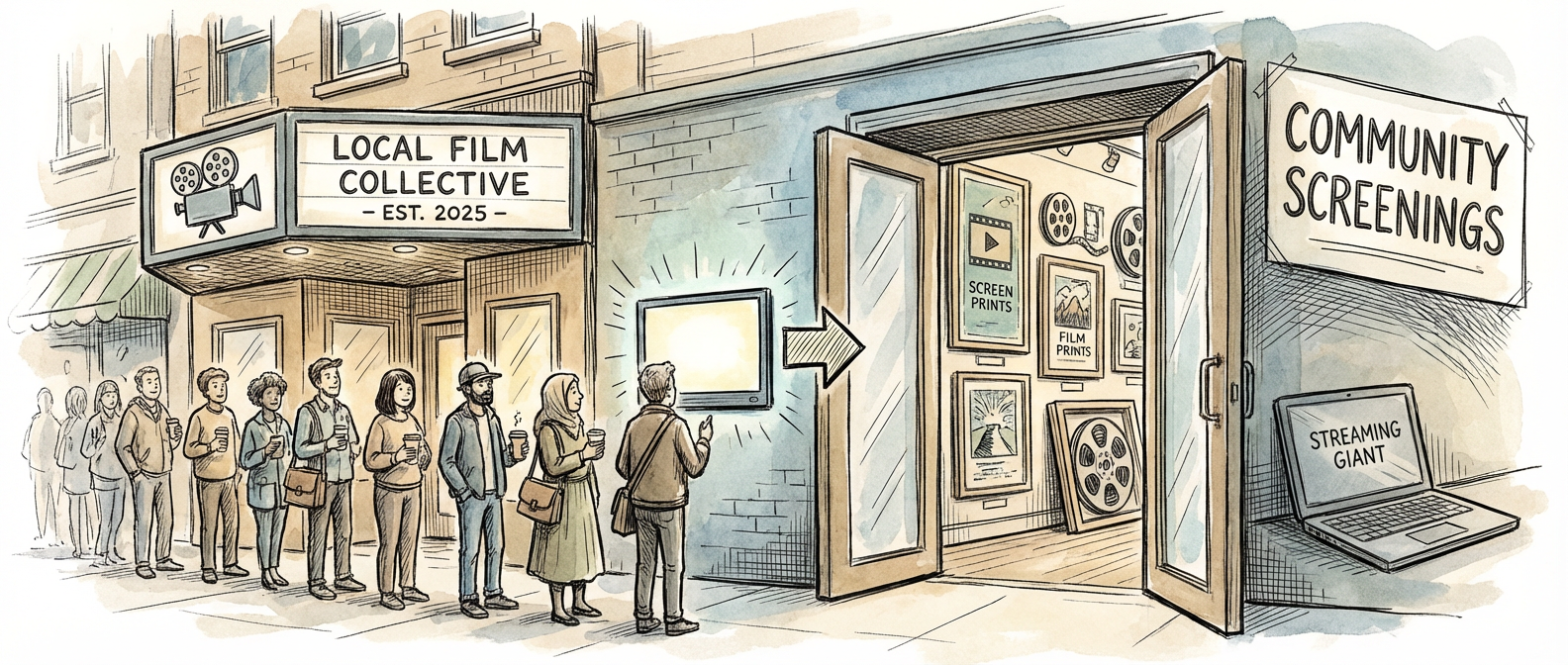
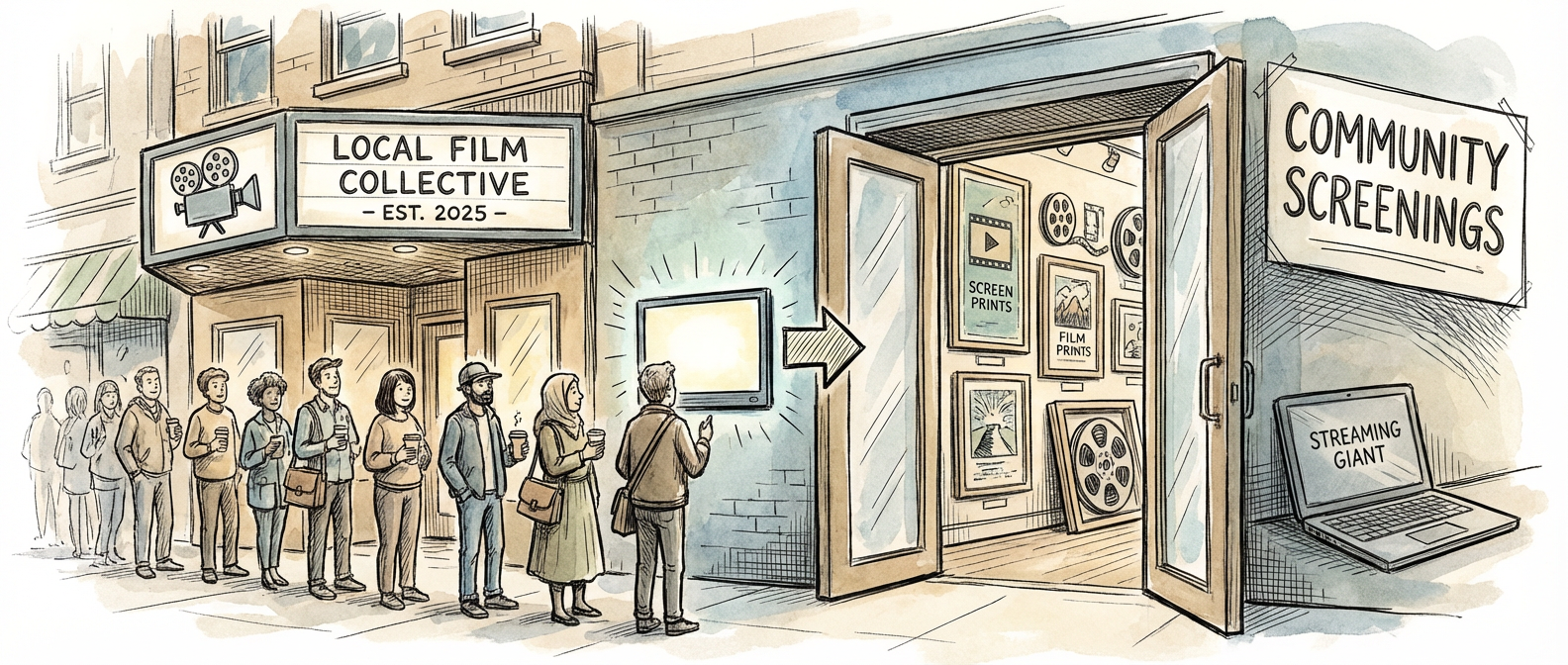
By the time we hit 2025, the numbers caught up to what the culture was already feeling. The number of registered independent cinema venues across the country nearly tripled in just three years, jumping from 340 spaces in 2022 to over 870 by early 2026. That’s not a trend. That’s a recalibration. People voting with their feet and their money, choosing to sit in rooms with strangers who wanted the same thing: to experience cinema as an event again, not as content consumed alone.

Think about what a gallery opening actually is. It’s not primarily about the art on the walls, though the art matters. It’s about the gathering. It’s about being in a room with people who have taste similar enough to yours that you want to know what they think. There’s a social energy that exists nowhere else. You dress a bit nicer. You arrive knowing that something intentional is happening. You expect to have a real conversation.

Independent micro-cinemas figured out they could build that same energy around film. The spaces themselves became part of the offering. A restored 1920s theater in Portland showing 16mm prints of silent films. A former warehouse in Detroit converted into an intimate screening room with a bar that actually understands beverage culture. A rooftop setup in Austin showing restored Criterion releases under the stars. These weren’t multiplex experiences sanitized for mass consumption. These were curated experiences designed by people who loved cinema enough to stake their credibility on their selections.

The programming reflected real taste-making rather than algorithmic calculation. Organizers weren’t trying to please everyone. They were trying to create something worth talking about. That specificity, that deliberate curation, became magnetic. In cities under 500,000 people, ticketed film screening events grew 78 percent faster than live music events in 2025. People had options for live entertainment. They chose cinema. That choice means something.

The Distribution Model That Changed Everything

What made this possible wasn’t just demand. It was infrastructure. The MUBI Go Live Program Details expanded dramatically throughout 2025, reporting a 55 percent year-over-year increase in partnerships with physical screening spaces. What MUBI understood, and what the industry had been slow to grasp, is that some films don’t need wide theatrical releases and streaming windows. Some films need community. They need the right room full of the right people at the right moment.

The logistics are worth understanding because they explain why this moment landed when it did. Independent distributors and platforms created pathways for micro-venues to access films that might never have played beyond a festival circuit or limited theatrical release. A theater with 50 seats in a mid-sized city could now show the same recent releases as a 400-seat art house downtown. The Cinema Foundation Independent Venue Census 2026 documented this shift in real time, revealing that the venues weren’t clustered in major metros. They were distributed across the country, often in places where cinema had been written off as a viable cultural experience.

The financial model worked because of pricing. People paid more for tickets to smaller venues because those tickets represented something, specifically curation and access. A micro-venue ticket wasn’t competing with Netflix. It was competing with a night out. When you frame it that way, eight to twelve dollars suddenly feels reasonable again.

The Pre-Release Phenomenon That Shattered Marketing Assumptions

Then Bong Joon-ho’s 2025 film “Mickey 17” arrived, and it proved something the industry had been too invested in traditional marketing to admit: grassroots momentum beats algorithm recommendations. The film screened at over 200 independent micro-venues before its wide release. By the time the $200 million marketing budget kicked into gear, the buzz had already been generated by people in rooms with other people, talking about what they’d just watched.

The pre-release screening strategy created anticipation that marketing budgets simply cannot manufacture. It was organic in a way that felt almost radical. Critics saw it. Cinephiles saw it. They told people. Those people bought tickets. And by the time the studio’s machinery engaged, it was amplifying something that already existed rather than trying to create desire from scratch. That’s a different economy of attention entirely.

What Happens When Supply Meets Demand This Perfectly

Cinespia, the Los Angeles-based collective that pioneered outdoor and micro-venue screenings, sold out all 42 of its events in 2025. Every single one. On the resale market, tickets were moving for an average of $85 on StubHub. Think about that figure. People were paying premium prices for the privilege of sitting outside watching a movie. Not because the movie was exclusive. Not because they couldn’t watch it at home. Because the experience was worth something.

This is what happens when supply meets demand with good timing. You have technological infrastructure that didn’t exist five years ago. Venues that were sitting empty or being repurposed for other things, suddenly activated as cultural anchors. Younger audiences who grew up on streaming and are discovering, almost by accident, that there’s something different about cinema as a collective experience. Curators and programmers who have been waiting for the culture to catch up to their vision. All of these forces aligned in 2025.

The question now isn’t whether independent cinema will continue to grow. The Cinema Foundation Independent Venue Census 2026 shows growth trajectories that suggest this isn’t a moment anymore. It’s becoming infrastructure. The real question is what stories you want to witness, what rooms you want to sit in, and who you want next to you when the lights go down.

Zines Are Back — But They’re AI-Hostile and That’s the Whole Point: The 2025 Print Underground Rebellion

The Rebellion Nobody Expected to See on Paper

Something shifted in the underground last year. Not the kind of shift you catch in real time. It’s the kind you notice when you’re standing in a gallery or a basement or somebody’s apartment and you realize half the people around you are holding things that feel expensive because they’re rare, not because they cost money. Zines are back. Not in some nostalgic, retro-boutique way where everyone’s pretending it’s 2003. This is different. People are explicitly rejecting the entire infrastructure of algorithmic generation and choosing to make magazines by hand, one at a time, on paper that could be recycled cardboard or weird specialty stock from a printer who’s been doing this for thirty years.

Zines Are Back — But They're AI-Hostile and That's the Whole Point: The 2025 Print Underground Rebellion
Zines Are Back — But They’re AI-Hostile and That’s the Whole Point: The 2025 Print Underground Rebellion

The numbers tell part of the story. Last year, Printed Matter’s annual art book fair, the oldest and most respected gathering of its kind in North America, saw a 28% jump in first-time zine exhibitors compared to just two years prior. But what matters more than the percentage is what those makers were saying when they set up their tables. They weren’t selling zines. They were selling proof. Proof that a human made this. Proof that no algorithm had a say in it. Proof that this thing in your hands came from a real person’s brain and their actual hands.

Illustration for Zines Are Back — But They're AI-Hostile and That's the Whole Point: The 2025 Print Underground Rebellion
Illustration for Zines Are Back — But They’re AI-Hostile and That’s the Whole Point: The 2025 Print Underground Rebellion

The Economics of “No Robots” as Aesthetic Principle

The marketplace figured this out faster than almost anyone predicted. Etsy, which has become the default storefront for independent print makers the way Instagram became the default gallery wall, released internal data in late 2025 that surprised nobody who’s been paying attention: zines and handmade print publications explicitly tagged as AI-free were moving at a 37% price premium compared to identical unmarked items. This wasn’t a small difference. This was customers saying they would literally pay more money to know for certain that their purchase didn’t involve a machine learning model anywhere in the production chain.

That’s not just a market correction. That’s a value system. And a lot of young people have signed onto it. When the Society of Publication Designers 2025 industry report surveyed independent print designers under thirty, 68% of them listed resistance to AI aesthetics as a primary reason for choosing analog production. These are people who grew up with smartphones in their pockets and who could, theoretically, use generative design tools to speed up their work. Instead, they’re choosing to spend four times as long on a project because they want to know where every choice came from.

Where the Movement Actually Lives

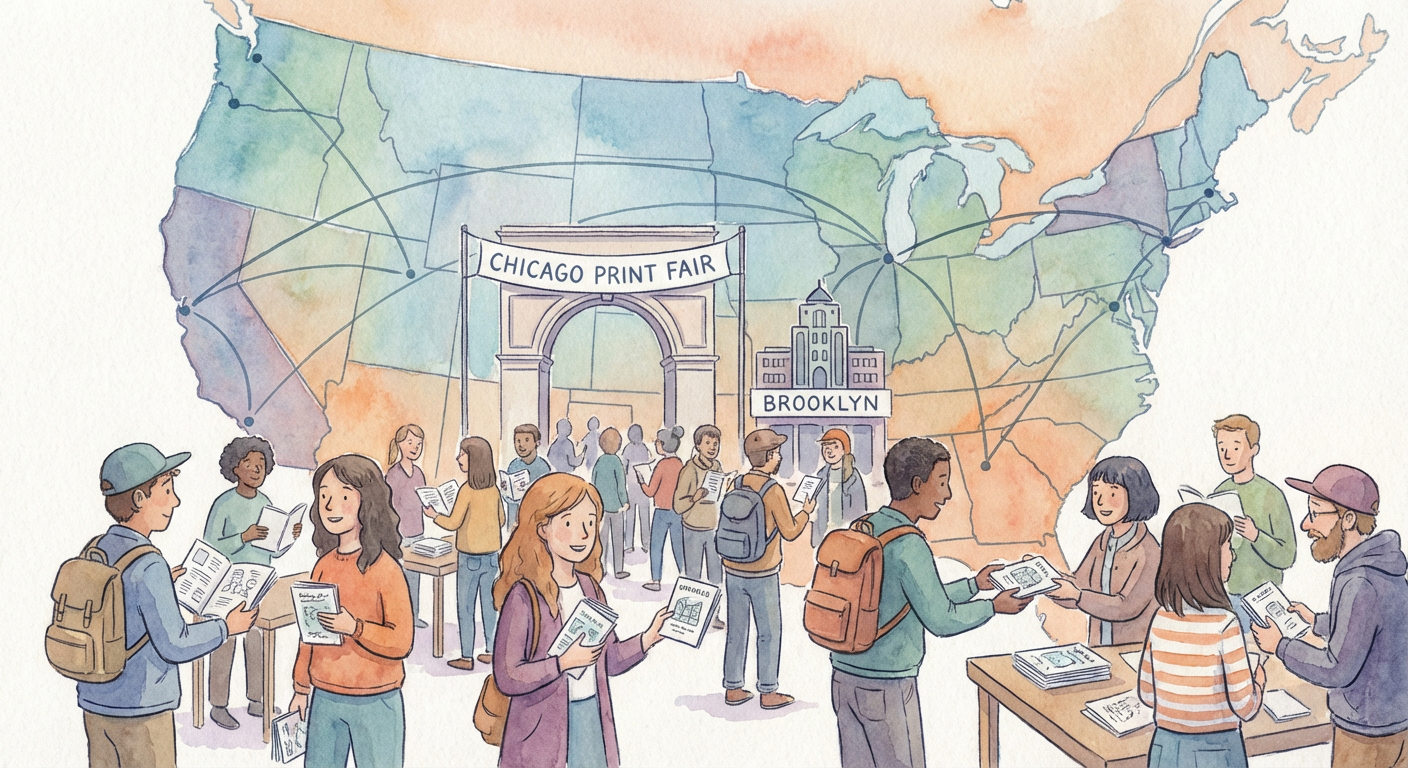
The No Robots collective started in Brooklyn in mid-2024 in that way that things start in Brooklyn, which is to say a few people noticed they were all angry about the same problem and decided to do something about it instead of just posting about it. By January of this year, they had over 3,000 registered zine makers affiliated across 14 American cities. In February, they hosted their first national print fair in Chicago. I talked to someone who went. She said it felt like the thing that printed-matter fairs used to feel like before they got too big and too professional. That exact density of intention.

The collective’s model is simple and radical by current standards: documentation that a zine was made without automated tools. No AI image generation. No algorithm-assisted layout. No machine learning anywhere in the pipeline. It sounds almost absurdly analog until you realize that this is genuinely valuable in a world where you can’t trust visual media anymore. A zine with a No Robots stamp on it is a zine you know you can trust to be what it claims to be.

What Happens When Print Outsells the Algorithm

In London, a small shop called Tenderbooks has been selling art books and zines for twelve years. In that entire period, zines were always secondary. Artist monographs were the main event. But in 2025, something inverted. Zine sales outpaced monograph sales for the first time in the store’s history. The zine section revenue increased 55% year-over-year. The shop’s owner, when asked about it, said something like: people are hungry for something they can actually verify. Something that carries proof of its own authenticity just by existing.

This matters because shops like Tenderbooks are where you find out what people actually want when the algorithm stops dictating the recommendations. They’re the physical world equivalent of what would happen if Instagram got shut down for a week. Real taste re-emerges. Community taste. Not algorithmic taste. And it turns out, when given the choice, a significant number of people want to buy things that come from another human’s hands. They want imperfection. They want irregularity. They want the proof.

The Permanent Lesson of This Moment

Zines aren’t coming back because they’re retro. They’re coming back because they’re honest. That’s a harder thing to build a movement around than nostalgia, and it’s a much better reason. When you put a stapler in someone’s hand and ask them to make a magazine, what they make will look and feel like something a person made. There’s no way around that. No filter between intention and result.

What we’re watching right now is people choosing friction. Choosing process. Choosing verification. It’s not a permanent victory against the machines. But it’s the establishment of something that actually matters: a space where human-made objects have explicit value. Where the fact of their creation is more important than their optimization. Where a zine made by hand, sold in a basement or at a fair or shipped in a padded envelope with a handwritten note, is worth more than the same zine could ever be if an AI had touched it anywhere.

If you want to understand where culture is actually moving right now, stop looking at what the algorithm is promoting. Go to a zine fair. Talk to the people making them. Buy something that came from human hands. Notice how it feels different. Then come back and tell me what you found.